Spruce Hill: A Local's Guide to West Philly's Victorian Village Around Clark Park
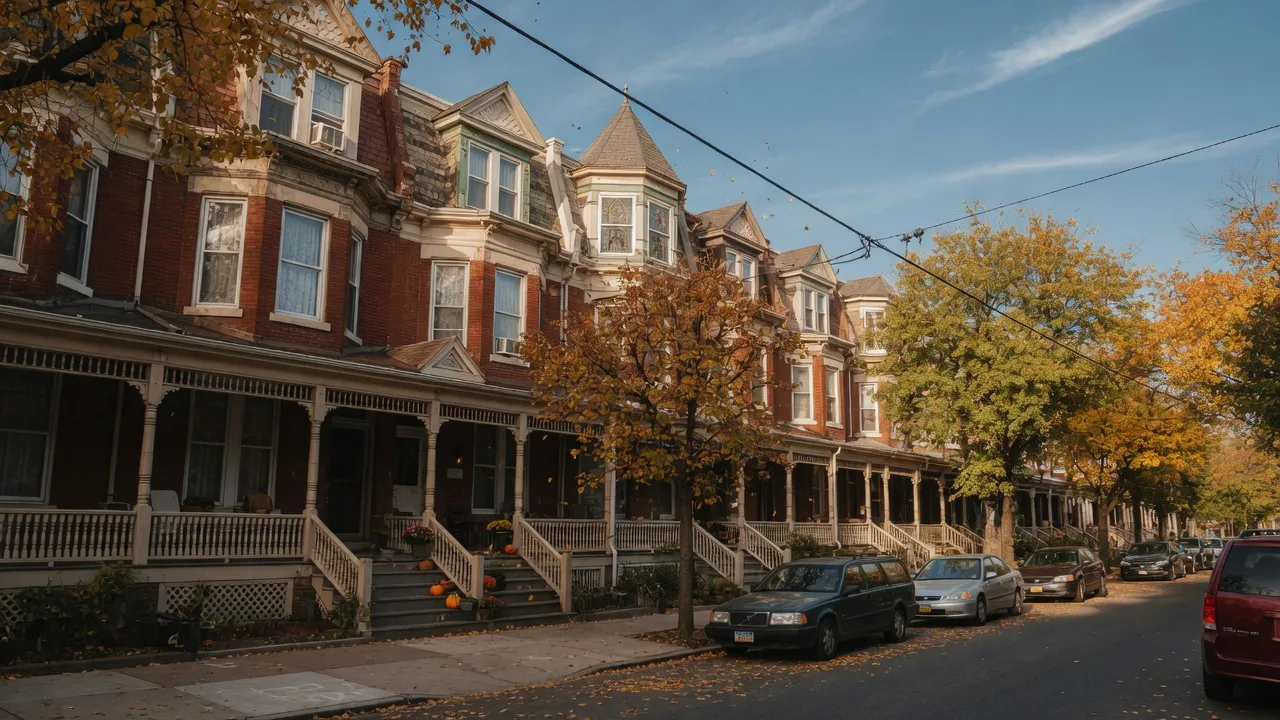
Spruce Hill is the West Philadelphia neighborhood built around Clark Park and Baltimore Avenue, a Victorian streetcar suburb whose brick and stone rowhouses, wide front porches, and tree-lined blocks have drawn neighbors since the late 1800s. It is the heart of what locals mean when they talk about "West Philly charm": a Saturday farmers market in the park, a restaurant row on Baltimore, a National Historic Landmark green space called The Woodlands at the river's edge, and the 34 trolley gliding down the avenue. Here is a local's guide to the neighborhood, and you can line it up against the rest of the city in our neighborhood directory.
Where Spruce Hill Sits in West Philly
Spruce Hill sits in the University City section of West Philadelphia, roughly bounded by Market Street on the north, Woodland Avenue on the south, and the corridor between 38th and 46th Streets. To the east it meets the institutions of University City, to the west it rolls toward Cedar Park and the rest of West Philadelphia, and to the south it drops toward the Schuylkill River and The Woodlands. It was built up between about 1850 and 1910 as one of the city's first true streetcar suburbs, a place designed for families who worked in Center City and rode the trolley home to a leafy block of their own.
That history still shapes the neighborhood today. The most prominent developer in Spruce Hill's early years was Clarence Howard Clark Sr., a financier who built dozens of rowhouses in the area and donated the land for the neighborhood's public library branch and its central park. His legacy, and that of the Victorian-era builders who followed, is the reason Spruce Hill is one of the most architecturally intact neighborhoods in the city, and the reason it is listed as part of the national West Philadelphia Streetcar Suburb Historic District.
Clark Park: The Neighborhood's Living Room
Clark Park is the 9.1-acre green at the heart of Spruce Hill, between 43rd and 45th Streets with Baltimore Avenue on one side and Woodland Avenue on the other. Clarence Clark gave the land to the city in 1895, and for more than a century it has been the neighborhood's gathering place: playgrounds and sports courts on the Chestnut Street side, wide lawns in the middle, and a gravel loop where neighbors walk their dogs all day long. On any given evening you will find pickup soccer, pickup basketball, families on blankets, and runners doing laps while the church steeples and rowhouse rooftops watch over the treeline.
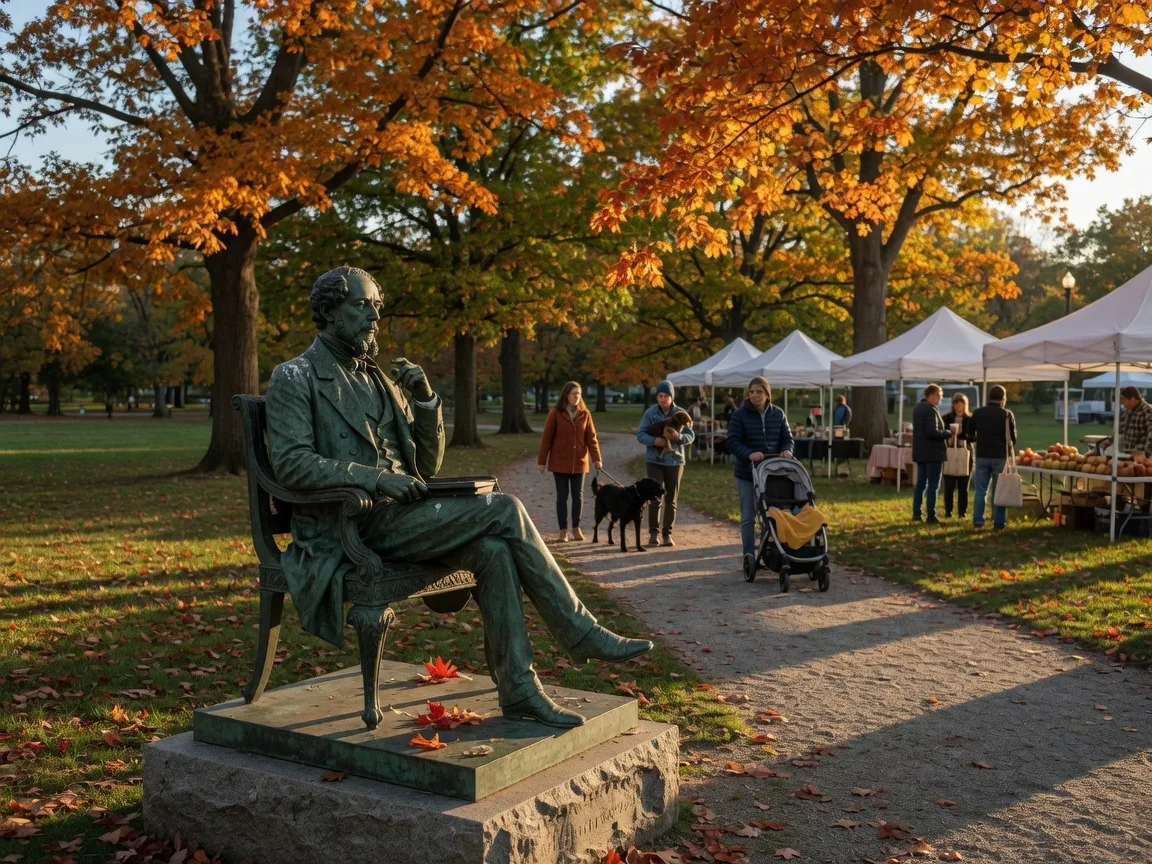
The park's most unusual landmark is its statue of Charles Dickens, cast in 1890 by sculptor Francis Edwin Elwell. It is one of only two known statues of the novelist in the world, and it stands on a pedestal near the park's edge, a beloved fixture that generations of neighborhood kids have grown up beside. Around it, the fall color in October is genuinely spectacular, with the maples and oaks turning gold and red against the red brick of the surrounding blocks.
The Clark Park Farmers Market
On Saturday mornings, Clark Park becomes one of the best farmers markets in Philadelphia. The Clark Park Farmers Market, run by The Food Trust, sets up at 43rd Street and Baltimore Avenue every Saturday from 10 a.m. to 2 p.m., year-round and rain or shine. You will find fresh fruits and vegetables through the season, locally roasted coffee, cheese, bread, and prepared foods, plus vendors selling clothes, jewelry, and crafts. It is the kind of market where you bump into half the neighborhood, and it anchors the whole Spruce Hill week.
The market is one of the city's most beloved, and it is a perfect example of why Spruce Hill works as a neighborhood: the park, the market, and the avenue all meet in one walkable corner. For the full rundown of where to shop across the city, from Rittenhouse to Headhouse to this one, see our guide to Philadelphia's best farmers markets.
Baltimore Avenue: The Restaurant Row
Baltimore Avenue is Spruce Hill's commercial spine, a lively restaurant row between roughly 43rd and 50th Streets that has become one of the most interesting dining streets in the city. The dining scene here is genuinely diverse and constantly evolving, anchored by long-running neighborhood favorites and newer arrivals alike. Vientiane Café at 4728 Baltimore has been serving its beloved Lao and Thai classics for decades, and Aksum next door at 4630 brings warm, generous plates to the corridor. Loco Pez at 4631 does a great taco and margarita scene, and Booker's Restaurant & Bar at 5021 has become a favorite for cocktails and Southern-influenced comfort food.
For coffee and daytime hangs, The Gold Standard Cafe at 4800 Baltimore is the neighborhood institution, with an outdoor patio that fills up on warm days, and Green Line Cafe at 4239 is the friendly West Philly staple for a working coffee. Clarkville at 4301 Baltimore is the neighborhood gastropub right at the park's corner. The corridor is promoted by the Baltimore Avenue Business Association, and every year the Baltimore Avenue Dollar Stroll turns the whole avenue into a street festival with one-night-only deals, live music, and art activities.
The Woodlands: A Landmark Green Space at the River
At the southern edge of Spruce Hill, along the west bank of the Schuylkill, sits The Woodlands, a 53-acre National Historic Landmark at 4000 Woodland Avenue. It began as the estate of William Hamilton, whose 1770 Federal-style mansion was so admired that Thomas Jefferson once called it the only rival in America to what could be seen in England. In 1840 the estate became a Victorian rural cemetery, and today its rolling lawns and winding paths hold the graves of artists like Thomas Eakins and Rembrandt Peale, as well as members of the Drexel and Biddle families.
The Woodlands is a working cemetery, a public park, and a cultural venue all at once. The mansion hosts exhibits and events, the grounds are open for walking, and in recent years it has become one of the city's most atmospheric places for a stroll or a concert. Its most talked-about feature is the towering monument to dental pioneer Thomas W. Evans, a 150-foot obelisk that is the tallest gravestone in the United States and the tallest obelisk gravestone in the world. It is an easy walk from the heart of Spruce Hill, and it doubles as the neighborhood's back gate to the Schuylkill riverfront. Our guide to Philadelphia's best parks and green spaces puts it in context with the rest of the city's outdoor gems.
Victorian Architecture on Every Block
Architecture is Spruce Hill's calling card. The neighborhood is filled with Queen Anne, Victorian, and Italianate rowhouses and twins, many with stained glass, ornate cornices, and deep front porches, and the historic designation protects the character that makes them so special. The most famous block is the group of Queen Anne houses at 4206-18 Spruce Street, built in 1886 by architects George and William Hewitt, which the city's architectural guide calls the most distinguished block of late 19th-century houses in Philadelphia. Look for their richly detailed facades, with their asymmetrical windows, towers, and decorative brickwork.
Another landmark is the Hanson Haines House at 46th and Springfield, a whimsical German Medieval Revival fantasy nicknamed "The Castle," complete with turrets and carved stonework that make it look like it wandered in from a fairy tale. In July 2024 the Spruce Hill Southeast Historic District was added to the Philadelphia Register of Historic Places, cementing official recognition of what residents have always known: this is one of the best-preserved Victorian neighborhoods in the country.
Schools and Family Life
For families, the anchor of the neighborhood is the Penn Alexander School, formally the Sadie Tanner Mossell Alexander University of Pennsylvania Partnership School, a K-8 public school at 4209 Spruce Street. Penn Alexander is a catchment school, and Spruce Hill families inside its boundary attend it; it is one of the most sought-after public schools in the city, a genuine partnership between the School District of Philadelphia and the University of Pennsylvania. The related neighborhood high school catchment is West Philadelphia High School at 4901 Chestnut Street, and the whole corridor is served by the University City district's broader family life, from playgrounds to the Free Library's Walnut Street West branch.
Family life in Spruce Hill centers on the park, the playgrounds, and the walkable streets, and the neighborhood has a strong community association that keeps things running. For a deeper look at how schools and neighborhoods fit together across the city, our family's guide to Philadelphia schools and neighborhoods is the place to start.
Getting Around: The 34 Trolley and Beyond
Spruce Hill was built for the streetcar, and the streetcar still runs. The SEPTA Route 34 trolley runs along Baltimore Avenue straight into Center City, which is why the neighborhood was originally settled by commuters and why it still works so well today. The Market-Frankford Line is a short walk north at 40th or 46th Street, and the 34th Street and 40th Street stations make the trip downtown fast. 30th Street Station, the city's regional rail hub, is a short trolley or bus ride east, and the University City bike network and the Schuylkill River Trail at the neighborhood's southern edge make car-free living genuinely practical.
Most Spruce Hill households get around with a mix of the trolley, the Market-Frankford Line, walking, and biking. Parking is the usual city challenge, so many neighbors plan for transit first and the car second. That walkability, combined with the neighborhood's Walk Scores in the high 80s and 90s, is a big part of why the streets stay so lively.
October in Spruce Hill
October is Spruce Hill at its very best. The trees in Clark Park turn gold and red, the Dickens statue sits in a frame of fall color, and the Saturday farmers market shifts to its autumn best, with apples, squash, cider, and the last of the season's produce. The Woodlands' lawns are gorgeous in the low October light, and the neighborhood's porches get a second life as the weather cools. Friends of Clark Park and the Spruce Hill Community Association keep a year-round calendar, and the Philadelphia events calendar tracks everything happening around the park and across the city as the season goes.
Is Spruce Hill Right for You?
Spruce Hill works best for people who want a genuine neighborhood in the middle of a big city: Victorian architecture, a park at the center of everything, a real restaurant row on Baltimore Avenue, a farmers market on Saturdays, and an easy trolley ride into Center City. It is a place where neighbors know each other, where families and professionals mix on the same blocks, and where the pace of life feels a little more human than a downtown high-rise. Homes here are in high demand, and the historic district means they hold their character, which is exactly why it helps to work with someone who knows the blocks block by block.
Thinking of Making West Philly Home?
Spruce Hill is everything people picture when they think of West Philly: Victorian porches, Clark Park on a Saturday morning, and a real neighborhood community. If you have been walking these blocks as a visitor and starting to think about making one of them home, I would love to help. With 26 years of experience in Philadelphia real estate, I know the buildings around the park, the market, and what each block is really like to live on.
Where to Go from Here
Spruce Hill is part of a wider West Philadelphia story. Head east for our University City neighborhood guide, with its universities, 30th Street Station, and the rest of the city's innovation corridor, or explore Cedarbrook and Wynnefield for other sides of West Philly living. The Moving to Philadelphia guide covers the whole city for newcomers, and our farmers markets guide will keep your Saturday calendar full. Then wander the neighborhood directory to see which of these blocks might be yours.
And when you find yourself lingering by the Dickens statue at golden hour, watching the market tents come down and the park clear out, that is the neighborhood working its magic on you. It happens to a lot of people in Spruce Hill.
With 26 years of experience in Philadelphia real estate, I help buyers and sellers navigate the city's neighborhoods with honest, local expertise. Licensed in PA (RS349905) and NJ (1969348).
Schedule a Consultation