Philadelphia Schools & Neighborhoods: A Family's Guide to Choosing Where to Live
If you're moving to Philadelphia with kids — or planning to start a family here — the first question you'll hear from other parents is always the same: "What school catchment are you in?" In a city with more than 200 public schools and hundreds of charter and private options, understanding how Philadelphia's school system actually works is the single most important factor in deciding where to live. This guide breaks down the catchment system, the magnet school application process, and the neighborhoods that families consistently talk about as the best places to raise kids in Philly.
How Philadelphia's School Catchment System Works
The School District of Philadelphia uses a catchment area system: your home address determines which neighborhood public school your child is guaranteed to attend. If you live within a school's catchment boundary, your child has a guaranteed seat at that school — no lottery, no application, no waiting list. You simply provide proof of residency and register.
This is the system that drives so much of Philadelphia's housing conversation. Homes within the boundaries of highly regarded catchment schools often command significant price premiums. In some cases, the difference between a home inside a sought-after catchment zone and a comparable home just a few blocks outside it can be $100,000 to $300,000. That's a big number, but it reflects real demand from families who see school quality as a non-negotiable part of their housing decision.
The catchment system also means that where you buy matters as much as what you buy. Two rowhouses that look identical can carry wildly different implications for your children's education based on which side of a boundary line they sit on. This is something I help families navigate constantly — checking the exact catchment designation of a property before they make an offer.
The Most Sought-After Public School Catchments
Several elementary school catchments in Philadelphia consistently draw strong demand from families. These schools have reputations for strong academics, active parent communities, and the kind of neighborhood involvement that makes a school feel like more than a building:
- Greenfield School (Center City / Rittenhouse catchment) — a K-8 school serving one of the most walkable neighborhoods in the city, with an engaged parent body and strong arts integration.
- Meredith Elementary (Queen Village / Bella Vista catchment) — widely regarded as one of the best elementary schools in the city, with consistent academic performance and a tight-knit community around it.
- McCall Elementary (Fitler Square / Graduate Hospital catchment) — a popular neighborhood school serving a rapidly growing area of South Philadelphia.
- Penn Alexander School (West Philadelphia / University City) — a partnership between the School District and the University of Pennsylvania, known for exceptional academic outcomes. The demand for homes in this catchment has reshaped housing prices across several blocks of West Philadelphia.
- Bache-Martin Elementary (Fairmount / Art Museum area) — a K-8 school in one of the city's most walkable and park-rich neighborhoods.
These schools aren't the only good ones — Philadelphia has dozens of strong neighborhood schools across different neighborhoods — but they're the names that come up most often in conversations with relocating families. Each of them has developed a parent community that actively fundraises, volunteers, and advocates for the school, which is part of what sustains their quality over time.
Magnet Schools and Citywide Admission: The Application Process
Beyond catchment schools, the School District of Philadelphia also operates criteria-based (special admission) schools and citywide admission schools. These are open to students from anywhere in the city, but admission requires meeting specific academic criteria or being selected through a lottery.
The most recognized criteria-based schools include Julia R. Masterman Laboratory and Demonstration School (consistently ranked among the top high schools in Pennsylvania), Central High School (the city's prestigious academic magnet), the Academy at Palumbo, and the George Washington Carver High School of Engineering and Science. These schools have rigorous college preparatory curricula and attract high-performing students from every neighborhood in the city.
The application process for these schools runs through the District's centralized School Selection system, which typically opens in the fall with deadlines around late October. Students must meet specific grade thresholds, attendance requirements, and standardized test scores to be eligible. Once deemed eligible, they're entered into an electronic lottery for admission. Students can rank up to five school preferences, and certain zip codes have been designated for enhanced consideration to promote student diversity across the city.
The key takeaway for families: start this process early. The application timeline matters, and the academic criteria are real. If your child is currently in a Philadelphia school, their guidance counselor can help you navigate the specific requirements for the current cycle.
The Best Family-Friendly Neighborhoods in Philadelphia
School quality is one piece of the puzzle. Parks, recreation, walkability, safety, and a genuine sense of community are the things that make a neighborhood actually feel good for raising kids. Here are the neighborhoods that families consistently point to as some of Philadelphia's best for family life:
Chestnut Hill
If you want a neighborhood that feels like a small village inside a big city, Chestnut Hill is the closest thing Philadelphia offers. The tree-lined streets of Germantown Avenue, the cobblestones, the Morris Arboretum — all of it gives this neighborhood a genuine garden-district feel. The public and private school options are strong, and the Wissahickon Valley trails give families direct access to hundreds of acres of nature right from the neighborhood's edge. Median home prices in Chestnut Hill run around $600K–$750K, which positions it as a premium family neighborhood — but the trade-off includes walkable daily life, excellent schools, and a community that actively supports family programming.
Queen Village & Bella Vista
These two adjacent South Philadelphia neighborhoods have become some of the most popular spots for young families in the city. The Meredith Elementary catchment is a major driver — families specifically seek out homes within its boundaries. Queen Village offers walkable daily life along South Street and the Delaware River waterfront, while Bella Vista has its own strong community feel anchored by places like Palumbo Recreation Center and the Bella Vista Farmers Market. Home prices here reflect the demand: median prices in both neighborhoods sit above $500K, with renovated rowhouses commanding premiums.
Fairmount
Fairmount's biggest asset for families is space — not inside the rowhouses, but outside them. This neighborhood sits directly adjacent to Fairmount Park, the largest urban park system in the country at more than 2,000 acres. The Bache-Martin K-8 school serves the area, and the walkability (Walk Score around 89) means most families can walk to the Art Museum, the Please Touch Museum, the Philadelphia Zoo, and the park's extensive trail system. It's the neighborhood where a Saturday morning means a stroller walk along Kelly Drive and a Sunday means the Schuylkill River Trail. Median home prices are around $520K.
Manayunk & Roxborough
For families who want a more suburban feel without leaving the city limits, Manayunk and Roxborough are a strong option. The K-8 schools in this corridor — including Cook-Wissahickon and James Dobson — are well regarded, and the neighborhood has direct access to the Schuylkill River Trail and the towpath for biking and walking. Main Street Manayunk has an active restaurant and cafe scene, and the community events (including the annual Manayunk Arts Festival) bring the whole neighborhood out. Median home prices hover around $365K, which is one of the reasons this area keeps growing in popularity with young families.
Mt Airy
Mt Airy is the Philadelphia neighborhood that's most often described as "different." The history of neighbors choosing to stay together, the mix of architectural styles, the strong civic infrastructure — all of it contributes to a neighborhood that takes community seriously. The Wissahickon trails are directly accessible, schools are diverse by design, and Germantown Avenue provides the village-center feel with independent bookstores, cafes, and restaurants. Median home prices around $430K make Mt Airy accessible to a wider range of family budgets than some of the neighborhoods closer to Center City.
How the "School Premium" Affects Home Prices
Here's the reality that every family relocating to Philadelphia should understand: school catchments directly affect home values. This isn't unique to Philadelphia — it's true in nearly every major American city — but the effect in Philly is pronounced because the city is so neighborhood-driven and the catchment boundaries are so clearly drawn.
A three-bedroom rowhouse inside the Meredith catchment in Queen Village can sell for $150K to $200K more than a comparable rowhouse a few blocks away in a different catchment. The Penn Alexander effect in West Philadelphia is even more dramatic — the University of Pennsylvania's partnership with the school created demand that reshaped housing prices across an entire corridor. According to reporting from WHYY and The Philadelphia Inquirer, homes in the Penn Alexander catchment have seen premiums of $100K+ compared to similar properties just outside the boundary.
What this means in practice: if school catchment is a priority for your family, you need to budget accordingly — and you need to verify the exact catchment of any property you're considering before you close. Catchment boundaries shift occasionally, and a house that's "close" to a good school may not actually fall inside its zone. This is one of the first things I check for any family client: I pull the specific catchment designation for the property address and confirm it with the District.
Parks, Recreation, and the Rebuild Initiative
Philadelphia's parks and recreation system is one of the city's underappreciated strengths. The city operates more than 100 parks and nearly 70 recreation centers — and the municipal Rebuild initiative is investing hundreds of millions of dollars into modernizing that infrastructure. In recent years, significant renovation projects have been completed or are underway at places like Happy Hollow Playground in Germantown (an $8.6 million renovation at Philadelphia's oldest recreation center), Piccoli Playground, and multiple rec centers and libraries across the city.
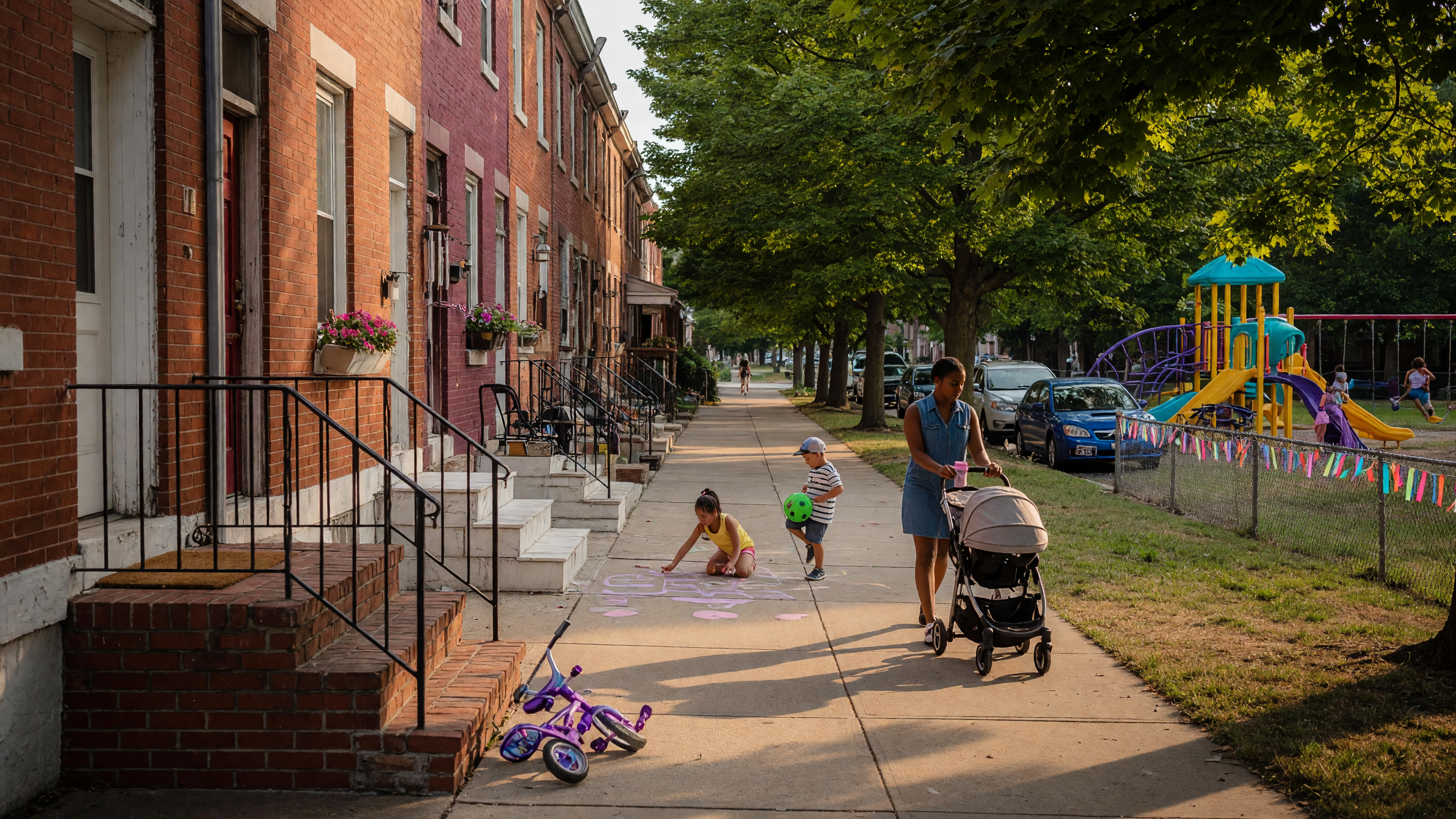
For families, this matters because it means recreation centers and playgrounds are not relics of a prior era — they're being actively maintained and improved. The rec center where your kid plays basketball or takes swim lessons may have been renovated in the last few years. The playground down the block may have new equipment and updated safety surfaces. This infrastructure is part of what makes Philadelphia livable for families on a daily basis, especially in neighborhoods where private backyards are small or nonexistent.
Private School Options
Philadelphia also has a robust ecosystem of independent and parochial schools. Some of the most recognized private schools in the area include Germantown Friends School (a Quaker school with strong academic outcomes in a family-oriented setting), Friends Select School (a Center City Quaker school from pre-K through 12th grade), The Episcopal Academy (in Newtown Square, known for its expansive campus), and Girard College (a tuition-free boarding school for students who meet eligibility requirements).
The choice between public and private is deeply personal and depends on your family's values, budget, and priorities. What I can say from 26 years involved with real estate in Philadelphia is that the public school landscape here is far more varied than the headlines suggest. There are genuinely excellent public schools across the city, and many families who move here specifically for the walkability, culture, and community find that the neighborhood catchment school exceeds their expectations.
Practical Steps for Families Relocating to Philadelphia
If you're planning a family move to Philadelphia, here's a framework that helps:
- Start with the school, not the house. Identify the catchment or school type that matters most to your family first, then look for homes within those boundaries. This prevents the heartbreak of falling in love with a house only to discover it's not in the catchment you want.
- Verify the catchment yourself. The School District of Philadelphia maintains an online tool for checking catchment assignments. Don't rely on listing descriptions or hearsay — confirm the specific address with the District or your realtor.
- Visit the school if possible. If you're relocating from out of town, try to schedule a visit during your house-hunting trip. A 30-minute school tour tells you more than any online ranking.
- Factor in the commute. A great school catchment doesn't help if the commute to work is an hour each way. Philadelphia's SEPTA system — buses, trolleys, and the Broad Street and Market-Frankford subway lines — makes many neighborhood-to-work commutes manageable without a car.
- Budget realistically. Homes in the most sought-after catchments carry premiums. Know your budget and be honest about what you can afford before you start looking. There are strong school options in neighborhoods at every price point in this city — you don't need to overextend.
The Bottom Line for Families
Philadelphia is a genuinely great city for raising kids. It's walkable in ways that many American cities aren't. The park system is massive. The cultural assets — museums, libraries, the Please Touch Museum, the Franklin Institute, the zoo — are world-class and accessible on a neighborhood level. And the school system, while imperfect and uneven (as every major city's is), has real strengths and options that families too often overlook.
The key is doing the work up front. Understand the catchment system. Research the schools that matter to you. Visit the neighborhoods. And then — once you know what you're looking for — the housing search becomes much more focused and much less overwhelming.
Relocating to Philadelphia with a Family?
I've spent 26 years involved with real estate in Philadelphia and the surrounding suburbs. If you're navigating school catchments, trying to understand which neighborhood fits your kids' needs, or just want an honest conversation about what's available in your price range, I'm happy to help. No pressure — just local knowledge from someone who knows this city.
With 26 years of experience in Philadelphia real estate, I help buyers and sellers navigate the city's neighborhoods with honest, local expertise. Licensed in PA (RS349905) and NJ (1969348).
Schedule a Consultation