Spring Garden: Philadelphia's Victorian Treasure

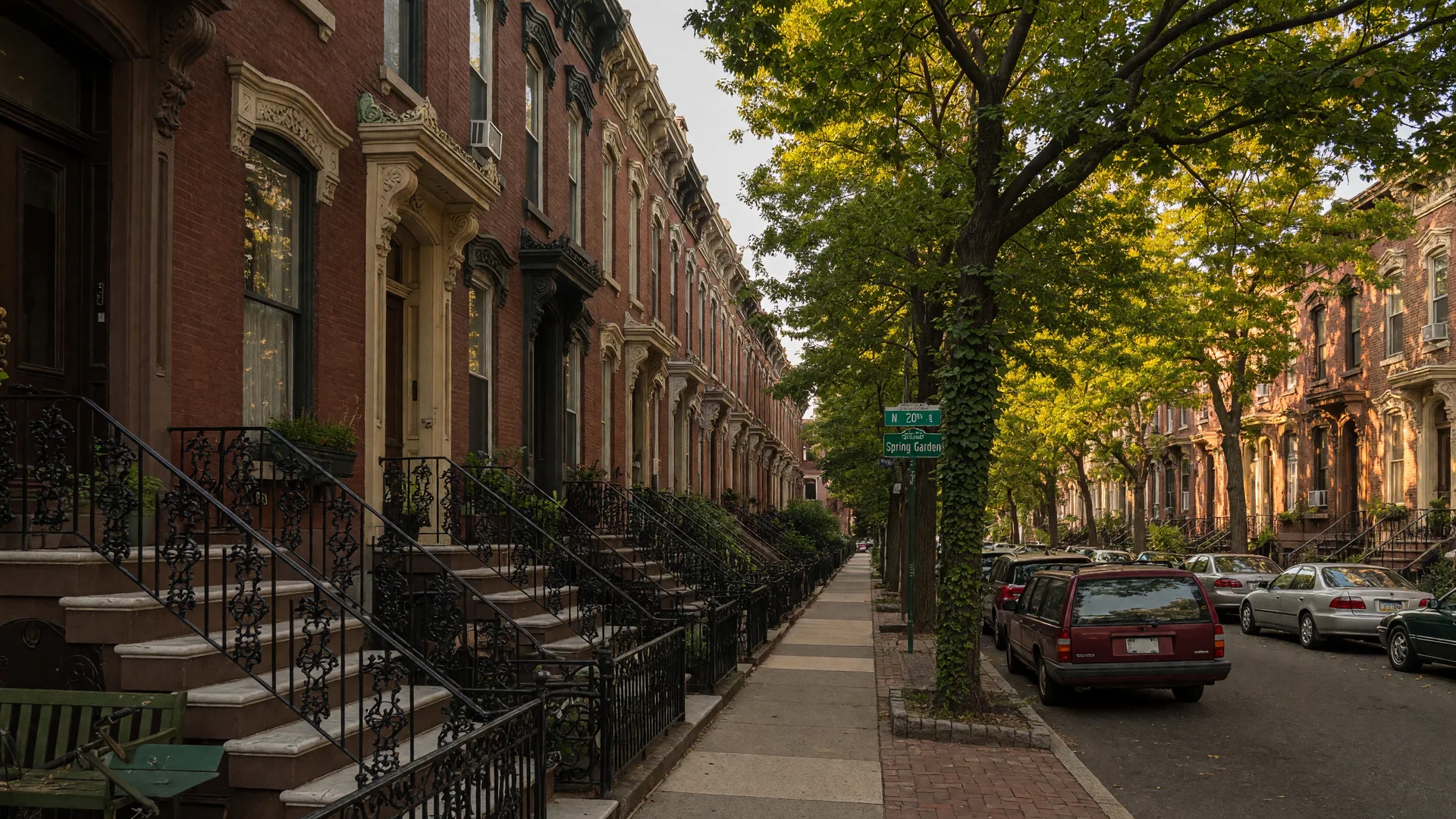
There is a block of Green Street between 17th and 18th that stops you in your tracks just about every time. The rowhouses are three stories of warm brick and brownstone, each one different from the next — some with ornate Italianate cornices, others with Greek Revival stoops and wrought-iron balconies. The trees arch overhead, the street is quiet, and in the late afternoon light the whole scene looks like a Victorian-era postcard that somehow survived into the present day. That block, and dozens more like it, is what makes Spring Garden one of the most distinctive and desirable neighborhoods in Philadelphia.
Where Spring Garden Fits in Philadelphia
Spring Garden sits just north of Center City, bounded roughly by Fairmount Avenue to the north, Broad Street to the east, the Schuylkill River to the west, and Vine Street to the south. It occupies a position that few Philadelphia neighborhoods can claim: it is close enough to City Hall to walk there in fifteen minutes, but its residential streets feel a world apart from the bustle of Market Street and the Parkway. The neighborhood's location puts it at the southern edge of what locals often call the "Art Museum area," with the Benjamin Franklin Parkway and its cultural corridor running along its southern boundary.
The geography is part of the reason Spring Garden works so well. The neighborhood sits on a gentle rise above the Schuylkill River, which gives many of the west-facing blocks views toward the river and the Fairmount Park tree canopy. The street grid is compact and exceptionally walkable, with a Walk Score of 95 that puts it among the most pedestrian-friendly neighborhoods in the city. From a home on Green Street or Mount Vernon Street, you can walk to the Philadelphia Museum of Art in under ten minutes, to the Barnes Foundation in eight, to Rittenhouse Square in fifteen, and to the Schuylkill River Trail in five.
The History: Philadelphia's First Victorian Suburb
Spring Garden's history sets it apart from every other neighborhood in Philadelphia. Originally part of William Penn's Springettsbury Farm, the area was developed in the mid-19th century as Philadelphia's first Victorian suburb — a place where the city's growing class of industrialists, merchants, and professionals could live in dignified rowhomes away from the crowding of the colonial core. The result was a neighborhood that was planned with an unusual attention to scale, light, and streetscape that still defines the experience of walking through it today.
The neighborhood was annexed by the City of Philadelphia in 1854, and the decades that followed brought a building boom that filled in the blocks with some of the finest Victorian residential architecture in the United States. The northern half of Spring Garden was designated a historic district in the 1970s, which means the rowhouses you see today are protected from the kind of unsympathetic alterations that have diluted the character of other historic neighborhoods. The result is one of the most intact collections of Victorian-era rowhomes anywhere in the country, with Italianate, Greek Revival, and Late Victorian styles standing side by side on blocks that have changed remarkably little in 150 years.
The Residential Blocks
The housing stock in Spring Garden is the neighborhood's strongest calling card. The streets are lined with three- and four-story brick and brownstone rowhouses, built between 1850 and 1880, with the kind of solid masonry construction that was standard for upper-middle-class homes of the era. Many have been lovingly restored and updated with modern interiors while preserving their original facades, and the consistency of the architecture gives Spring Garden a visual cohesion that newer neighborhoods cannot replicate.
The best blocks are the ones that run east-west between 16th and 21st Streets — Green Street, Mount Vernon Street, Brandywine Street, and Wallace Street. These are the streets where the tree canopy is fullest, the rowhouse frontages are widest, and the scale feels most residential. The neighborhood also has a handful of carriage houses and smaller alley homes tucked behind the main blocks, which add another layer of architectural interest and provide entry points at slightly lower price points.
As of mid-2026, the median home sale price in Spring Garden sits in the $385,000 to $475,000 range, with significant variation depending on block and condition. A restored two-bedroom rowhouse on a historic block typically lists between $375,000 and $450,000, while larger three-bedroom homes with modern kitchens and finished basements can reach $550,000 to $700,000. Compared to Rittenhouse Square, where comparable square footage costs 30 to 40 percent more, Spring Garden offers genuinely strong value for buyers who want historic character and Center City proximity without the premium of the most famous addresses.
Museum Row: Art at Your Front Door
Spring Garden's southern edge puts it on the doorstep of Museum Row, the cluster of world-class cultural institutions that line the Benjamin Franklin Parkway. The Barnes Foundation, with its unparalleled collection of Impressionist and Post-Impressionist paintings by Renoir, Cezanne, Matisse, and Van Gogh, is an eight-minute walk from most Spring Garden blocks. The Rodin Museum — the largest collection of Auguste Rodin's work outside Paris — sits on the Parkway between the Barnes and the Art Museum, and its serene garden is one of the most underappreciated outdoor spaces in the city.
The Philadelphia Museum of Art crowns the top of the Parkway, and for Spring Garden residents it functions as more than a tourist destination. The museum's membership programs make it practical to visit regularly — a Tuesday evening spent wandering the Impressionist galleries or the period rooms becomes a routine pleasure rather than a special occasion. The Rocky Steps out front double as a running route, a sunset-viewing spot, and an informal gathering place. And the Fairmount Water Works, the historic 19th-century pumping station at the base of the Art Museum hill, has been restored as an interpretive center with exhibits on the Schuylkill River and Philadelphia's water history.
The Benjamin Franklin Parkway: The Neighborhood's Front Yard
The Parkway runs along Spring Garden's southern edge and serves as the neighborhood's connection to the rest of the city. This grand boulevard, modeled on the Champs-Elysees, runs from City Hall to the Art Museum through a corridor of public art, tree-lined medians, and civic institutions. Walking south from Spring Garden toward Center City, you pass the Central Library of Philadelphia, the Cathedral of Saints Peter and Paul, and the Academy of Natural Sciences, all within a ten-minute stroll.
For Spring Garden residents, the Parkway is a daily amenity. It hosts the Philadelphia Marathon course, the city's Fourth of July fireworks, outdoor summer concerts, and a growing roster of seasonal festivals. On a summer evening, the Parkway fills with joggers, dog walkers, and families making their way between the playgrounds and the museums. The wide sidewalks and protected bike lanes make it one of the most pleasant urban corridors in the city, and its proximity to Spring Garden means the neighborhood never feels cut off from the energy of Center City.
The Dining and Cafe Scene
Spring Garden's dining scene is modest but well-curated, anchored by neighborhood institutions that have been serving the community for years. Sabrina's Cafe on Callowhill Street is a beloved neighborhood brunch spot — the kind of place where the weekend wait is part of the routine and the omelets and stuffed French toast keep people coming back. The outdoor seating on warm mornings makes it a true neighborhood gathering spot.
Pizzeria Vetri on Callowhill Street serves some of the best Neapolitan-style pizza in the area, with a consistently excellent margherita and a cozy, understated dining room. Jack's Firehouse on Fairmount Avenue, just a few blocks north, is a Spring Garden-area institution housed in a converted 19th-century fire station, serving American comfort food with a Southern accent in a setting that feels both historic and welcoming.
For coffee and daytime hangs, Vineyards Cafe at 16th and Green is a quiet, dependable spot with good espresso and a relaxed atmosphere. Musette on Aspen Street doubles as a bike shop and cafe, which makes it a natural stop for anyone heading out on the Schuylkill River Trail. The neighborhood also benefits from its proximity to the dining corridors of Fairmount to the north and Center City to the south, so a fifteen-minute walk opens up hundreds of additional options.
Matthias Baldwin Park and Outdoor Spaces
Spring Garden's centerpiece green space is Matthias Baldwin Park, a small but beautifully maintained park at 18th and Green Streets that serves as the neighborhood's backyard. The park features a playground, benches, shade trees, and the statue of Matthias Baldwin, the 19th-century locomotive manufacturer whose factory once anchored the neighborhood's industrial economy. The park hosts community events, outdoor concerts, and the kind of informal gatherings that give Spring Garden its village-like atmosphere.
For more ambitious outdoor pursuits, the Schuylkill River Trail is a five-minute walk from most Spring Garden blocks. The trail runs along the river from the Art Museum all the way to Manayunk and the Wissahickon Valley Park to the northwest, and it connects to Center City and the Convention Center to the southeast. Morning runs, evening bike rides, and weekend walks along the river are part of the daily rhythm for many Spring Garden residents.
Getting Around
Spring Garden is one of the best-connected neighborhoods in Philadelphia. SEPTA's Broad Street Line has a station at Spring Garden Street and Broad Street, providing direct subway access to Center City, the Sports Complex, and South Philadelphia in under fifteen minutes. The Bus Route 48 runs along Fairmount Avenue, connecting Spring Garden to Brewerytown and Fishtown. Multiple bus routes serve Broad Street and the Parkway, and the SEPTA Regional Rail is accessible from 30th Street Station and Market East.
By car, the Vine Street Expressway (I-676) provides direct access to I-76 and the suburbs, and the neighborhood's position just north of Center City makes it surprisingly convenient for car commuters. Parking is manageable compared to neighborhoods like Rittenhouse Square or Old City, with permit parking on most residential streets and a handful of garages in the area. For cyclists, Spring Garden Street has designated bike lanes that connect to the Schuylkill River Trail and the city's growing network of protected routes.
What Day-to-Day Life Feels Like
The thing that strikes you about Spring Garden, especially if you come from one of Philadelphia's trendier neighborhoods, is how settled it feels. The streets are quiet in the best sense of the word — not empty, but calm in a way that comes from a neighborhood where people have lived for decades and plan to stay. You see the same faces at Sabrina's on a Saturday morning. You recognize the dogs at Baldwin Park. The rhythm of daily life is unhurried and residential, even though Center City is a fifteen-minute walk away.
The demographic mix is part of what makes it work. Spring Garden has long attracted a blend of longtime homeowners, young professionals drawn by the architecture and location, and families who value the neighborhood's schools and park access. The block associations are active, the community garden at 17th and Green is well-tended, and there is a genuine sense of neighborliness that can feel rare in a city of 1.6 million people.
For families, Spring Garden offers some of the best public school options in the immediate Center City area. The neighborhood feeds into Meade Elementary and Spring Garden Elementary, both of which serve the community well, and several strong magnet, charter, and private schools are accessible from the area. The proximity to the Please Touch Museum in Fairmount Park, the playgrounds at Matthias Baldwin Park, and the cultural institutions on the Parkway make Spring Garden a genuinely family-friendly urban environment.
The Architectural Pedigree
Spring Garden's architecture deserves special attention because it is the neighborhood's defining feature. The Spring Garden Historic District, listed on the National Register of Historic Places, includes over 1,200 contributing buildings, most of them mid-to-late 19th-century rowhouses in Italianate, Second Empire, and Greek Revival styles. The district is bounded roughly by Fairmount Avenue, Broad Street, and Spring Garden Street, and walking through it is like walking through a living museum of Victorian residential design.
The details are what make it special. Wrought-iron balcony railings, bracketed cornices, arched windows with keystones, and stoops with ornate ironwork are present on block after block. The brickwork is Philadelphia's signature blend of red and brown tones, consistent in scale but varied in pattern. The streetscape has a rhythm and a dignity that comes from a time when rowhouse design was taken seriously as a civic art, and the fact that so much of it survives intact makes Spring Garden a genuinely world-class architectural neighborhood.
Is Spring Garden Right for You?
Spring Garden is ideal for anyone who values historic character, walkability, and cultural access above all else. It works beautifully for professionals who work in Center City and want a commute that involves walking past the Barnes Foundation and the Rodin Museum. It suits families who want a settled, established neighborhood with good schools and park access. And it is a strong choice for anyone who appreciates architecture and wants to live in a place where every block has something worth looking at.
What Spring Garden does not offer is a bustling nightlife scene or a dense concentration of restaurants. The neighborhood is residential first, and while it has a handful of excellent dining options, you will walk to Fairmount, Brewerytown, or Center City for the kind of variety that neighborhoods like Fishtown or Passyunk Square deliver within their own borders. The housing stock is almost entirely historic, which means lower levels of modern construction standards and the maintenance responsibilities that come with a 150-year-old rowhouse.
But for the people who choose Spring Garden, those trade-offs are the whole point. The neighborhood offers something that few Philadelphia addresses can match: the experience of living in a genuinely well-preserved piece of the city's architectural history, in a location that puts the best of Center City at your feet, on streets that have kept their character for a century and a half. It is a neighborhood that rewards a slow, deliberate approach — the kind of place where the more time you spend walking its blocks, the more you understand why the people who live here tend to stay.
If Spring Garden sounds like the kind of place you could call home, I would encourage you to come see it for yourself. Park at 18th and Green and walk the blocks between there and the Art Museum. Have brunch at Sabrina's. Walk through Baldwin Park. Stand at the corner of 18th and Spring Garden and watch the light come through the trees onto the brownstone stoops. There is a reason this neighborhood has been one of Philadelphia's most desirable addresses for over a century, and it is still revealing itself to people who take the time to look.
Thinking about buying or selling in Spring Garden?
Whether you are exploring Spring Garden as a potential home or you are a current homeowner curious about your property's value, I would love to help. With 26 years of experience in Philadelphia real estate, I can give you the honest, local perspective you need to make a confident decision.
With 26 years of experience in Philadelphia real estate, I help buyers and sellers navigate the city's neighborhoods with honest, local expertise. Licensed in PA (RS349905) and NJ (1969348).
Schedule a Consultation