Society Hill: Philadelphia's Most Historic Neighborhood, Block by Block

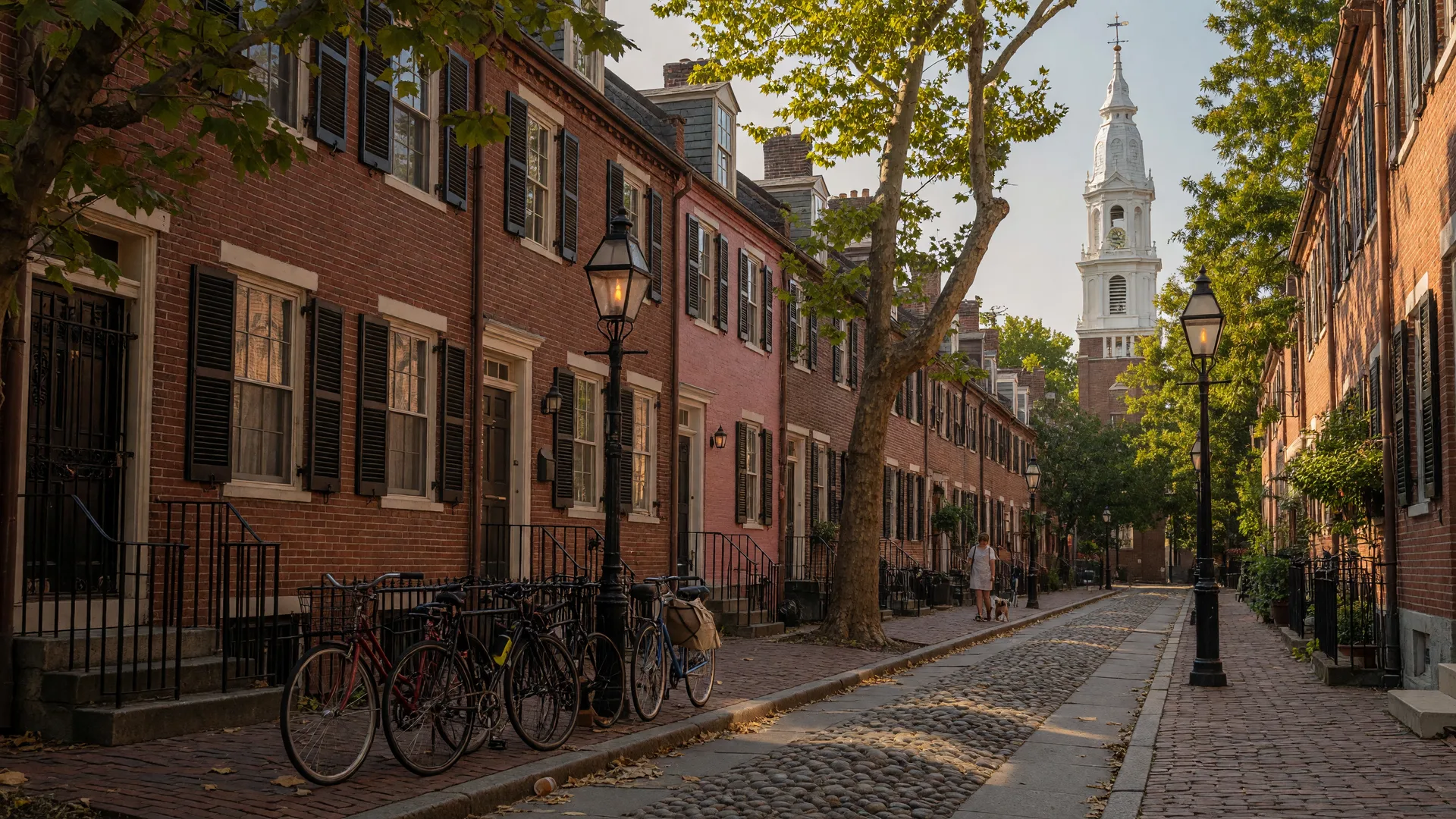
There is a neighborhood in Center City East where the streets are still paved in cobblestone, the sidewalks are laid in brick, and the gas lamps flicker on at dusk the same way they did two centuries ago. Society Hill is not a museum piece — it is a living, breathing neighborhood where some of the most meticulously preserved Federal and Georgian rowhouses in America sit steps from a park that William Penn himself designated in 1682. It is also one of the most walkable, prestigious, and quietly beautiful places to live in Philadelphia. Here is everything you need to know.
Where Exactly Is Society Hill?
Society Hill sits in Center City East, roughly bounded by Front Street to the east, 8th Street to the west, Walnut Street to the north, and Lombard Street to the south. The neighborhood shares borders with Old City to the east, Washington Square West to the west, and Queen Village to the south. It covers the 19106 and 19147 ZIP codes, and its compact, walkable grid makes it one of the easiest neighborhoods in Philadelphia to navigate on foot.
The name "Society Hill" comes from the Free Society of Traders, a London trading company that William Penn granted land to in 1682. The "Society" in the name refers to that company, and the "Hill" describes the gentle rise in the land near the Delaware River. It is a name that has stuck for more than three centuries, and it carries the weight of a neighborhood that has been continuously occupied and continuously evolving since the earliest days of the city.
A Walk Through History: From Penn to Urban Renewal
Society Hill's story is, in many ways, the story of Philadelphia itself. The neighborhood was developed in the late 17th and early 18th centuries as Philadelphia grew east of the Schuylkill toward the Delaware River. Some of the wealthiest merchants and ship captains built their homes here, taking advantage of the elevated ground and the proximity to the bustling port along the Delaware waterfront.
By the 19th century, Society Hill was home to Philadelphia's social elite. The Powel House at 244 S. 3rd Street was the residence of Samuel Powel, Philadelphia's last colonial mayor and the first mayor under the new republic — his lavish dinner parties hosted everyone from George Washington to Benjamin Franklin. The Hill-Physick House at 321 S. 4th Street, built in 1786, is the last free-standing Federal-style mansion in the city and was home to Dr. Philip Syng Physick, known as "the father of American surgery."
In the 20th century, Society Hill fell into decline as wealthier residents moved to newer neighborhoods farther west. By the 1950s, much of the historic housing stock was in serious disrepair. Then came one of the most ambitious urban renewal projects in American history. Under the vision of city planner Edmund Bacon and with architectural contributions from I.M. Pei, the city launched a massive restoration effort in the late 1950s and 1960s. Hundreds of historic rowhouses were purchased, restored, and resold. The Society Hill Towers — three striking 30-story modernist residential towers designed by I.M. Pei — were built at 2nd and Locust Streets, adding a bold contemporary contrast to the Federal-era streetscape. Washington Square was renovated. Cobblestone streets were restored. Franklin gas lamps were installed throughout the neighborhood.
The result is the Society Hill you see today: a neighborhood that manages to be both historically authentic and genuinely livable, where 18th-century architecture coexists with modernist high-rises and meticulously maintained parks.
Did you know? Society Hill is home to the largest concentration of original 18th- and early 19th-century architecture in the United States. More than 700 historic buildings are preserved within the neighborhood's boundaries, protected by one of the country's earliest historic district designations.
The Housing Market: Historic Character at a Premium
Society Hill is one of Philadelphia's most expensive neighborhoods, and for good reason. You are paying for location, history, architecture, and a level of streetscape beauty that few other neighborhoods in any American city can match.
As of mid-2026, the median home sale price in Society Hill sits around $584,000, though prices vary widely depending on the property type. A fully restored Federal-era rowhouse on a cobblestone block with original marble steps, working shutters, and a private garden can command well over a million dollars. A one-bedroom condo in the Society Hill Towers might start in the mid-$300,000 range. The median price per square foot is approximately $414, reflecting the premium attached to historic properties in a protected district.
The housing stock is overwhelmingly historic brick rowhouses dating from 1750 to 1830, with Federal and Georgian architectural styles dominating the streetscape. Many have been meticulously restored with modern kitchens and bathrooms while preserving original details — marble fireplace mantels, wide-plank pine floors, exposed brick walls, and period staircases. You will also find modern condominiums in the Society Hill Towers, along with newer townhouse developments that have been designed to blend with the historic fabric.
Homes typically spend about 57 days on the market, and the market is considered "somewhat competitive." Median rent in the neighborhood runs around $2,028 per month. For buyers, the combination of historic preservation protections and prime Center City location means that Society Hill real estate tends to hold its value well over time — though the market has seen some softening in 2026, with prices down roughly 9% year over year, creating potential opportunities for serious buyers.
Walkability and Getting Around
Society Hill earns a Walk Score of 97 out of 100 — "Walker's Paradise." Almost every daily errand, restaurant meal, and social outing can be accomplished on foot. The neighborhood's compact grid, tree-lined streets, and proximity to Center City's commercial corridors make it one of the most walkable neighborhoods not just in Philadelphia, but in the entire country.
Transit: The Market-Frankford Line (the El) has stations at 2nd Street and 5th Street, both within a short walk of most Society Hill addresses. The SEPTA Bus Route 12 runs along Walnut Street, and the Route 21 and Route 42 buses serve Chestnut Street. Jefferson Station on the Regional Rail network is about a 10-minute walk north on 11th Street. The Philly PHLASH downtown circulator also runs through the neighborhood, making it easy to hop between Society Hill, Old City, and Rittenhouse Square.
For drivers, Society Hill is centrally located with easy access to I-95 (via the Delaware Expressway) and the Vine Street Expressway (I-676). Parking is predominantly street parking with residential permit zones, though many historic rowhouses do not have off-street parking. Some newer condominium buildings offer garaged parking, and there are several public lots in the area. In practice, most Society Hill residents walk, bike, or take transit for daily errands and use a car primarily for weekend trips or groceries.
The Landmarks That Define the Neighborhood
Society Hill contains more historic landmarks per square block than almost any other neighborhood in America. Here are the ones worth knowing:
- ● Washington Square — One of William Penn's five original public squares, this 6.4-acre park at 6th and Walnut Streets is the heart of the neighborhood. The Tomb of the Unknown Revolutionary War Soldier sits at its center, and the park is surrounded by the graceful facades of historic rowhouses and the Athenaeum of Philadelphia (a National Historic Landmark library). It is the neighborhood's living room — people picnic here, read here, and walk their dogs here every day.
- ● Head House Square — At 2nd and Lombard Streets, this open-air market building constructed in 1804 is one of the oldest market structures in the country. From May through October, the Head House Farmers Market sets up here every Sunday, drawing vendors and shoppers from across the city. The square is surrounded by restaurants, cafes, and the sort of casual outdoor seating that makes summer evenings in Society Hill feel like a European postcard.
- ● St. Peter's Church — At 3rd and Pine Streets, this 1761 Georgian church designed by Robert Smith is one of the most beautiful religious buildings in Philadelphia. Its distinctive spire is visible from blocks away, and the churchyard cemetery holds the graves of several notable Philadelphians. The church is still active, and its doors are open to visitors.
- ● Mother Bethel A.M.E. Church — At 419 S. 6th Street, this is one of the oldest continuously owned church properties in the United States. Founded in 1787 by Richard Allen, Mother Bethel is the mother church of the AME denomination. The current building, built in 1889, houses a museum dedicated to Allen's life and the history of the AME church.
- ● Powel House — 244 S. 3rd Street. Built in 1765 and open for tours, this Georgian townhouse was home to Samuel Powel, Philadelphia's last colonial mayor. The interior has been restored to its 18th-century appearance, complete with period furnishings, and the gardens are some of the most beautiful in the neighborhood.
- ● Society Hill Towers — Designed by I.M. Pei and completed in 1964, these three 30-story towers at 2nd and Locust Streets are a striking modernist counterpoint to the neighborhood's historic rowhouses. The towers sit in a landscaped plaza with fountains and sculptures, creating one of the most distinctive residential settings in the city.
The Dining Scene
Society Hill's dining scene is more refined than some of its neighbors — you will find fewer late-night taco spots and more wine bars, white-tablecloth restaurants, and cozy neighborhood bistros. The dining reflects the neighborhood's character: elegant, understated, and focused on quality rather than trends.
Along Head House Square and the surrounding streets, you will find a cluster of restaurants that make the most of the neighborhood's historic setting. Race Street Cafe at 2nd and Race offers a warm, inviting atmosphere and American fare in a historic building near the market. The New Wave Cafe on 3rd Street is a reliable neighborhood spot with good bar food and a friendly local crowd.
For casual breakfast and brunch, Green Eggs Cafe on Locust Street is a short walk from the neighborhood's western edge and consistently draws lines for its creative takes on morning classics. For coffee, Herman's Coffee on 3rd Street is a local favorite with a loyal following for its pour-overs and pastries.
Society Hill's dining also benefits from its location. You are a 10-minute walk from the restaurants of Old City (including the culinary destination Zahav on 2nd Street, Michael Solomonov's award-winning Israeli restaurant), a 10-minute walk from Washington Square West, and a 15-minute walk from Rittenhouse Square's fine dining corridor. In practice, this means Society Hill residents have access to some of the best restaurants in Philadelphia without needing to leave their neighborhood footprint.
Parks and Public Spaces
Society Hill is blessed with extraordinary public green spaces, anchored by Washington Square at the neighborhood's western edge. The park underwent a $5 million restoration in 2022 that improved its pathways, lighting, and landscaping, and it is now one of the most beautifully maintained urban squares in the country. The square fills with sunbathers on warm afternoons, dog walkers in the early morning, and families on weekend afternoons. It is also the site of numerous community events throughout the year, including summer concerts and holiday celebrations.
Nearby, Head House Square offers a more intimate public gathering space with its market stalls and surrounding restaurants. Dock Street, a pedestrian-friendly street near the Society Hill Towers, is closed to traffic and functions as a de facto park space with benches and plantings. And the Delaware River Waterfront, including Spruce Street Harbor Park and the Race Street Pier, is a five-minute walk east from the neighborhood's edge — giving Society Hill residents waterfront access that rivals any neighborhood in the city.
Schools and Families
With a median age of 52 and only about 10% of households having children, Society Hill skews older and more established than many Philadelphia neighborhoods. But families who do live here have access to excellent educational options.
The neighborhood is served by the General George A. McCall School (K–8) at 325 S. 7th Street, consistently one of the highest-rated public schools in the School District of Philadelphia. McCall has a strong reputation and draws families from across Center City. The Masterman School (5–12), Philadelphia's premier magnet school at 17th and Spring Garden Streets, is accessible by a 15-minute bus ride from the neighborhood.
For private school families, Society Hill sits within easy reach of several of Philadelphia's top independent schools. Friends Select School on the Parkway is a 15-minute walk. St. Peter's School at 3rd and Lombard Streets is a highly regarded Episcopal day school for grades Pre-K through 8, located directly in the neighborhood at 319 Lombard Street. The proximity to the museums, historic sites, and cultural institutions of Center City also means that weekends are filled with field-trip-quality experiences without ever getting in the car.
The Vibe
Society Hill has a quiet elegance that sets it apart from every other neighborhood in Philadelphia. The streets are quiet — not dead, but calm in a way that feels intentional. Walking down Latrobe Street or Spruce Street between 3rd and 4th, with the brick sidewalks and the gas lamps and the meticulously maintained facades, you feel like you have stepped into a different era. But then you turn a corner and see the Society Hill Towers rising above the treeline, a reminder that this is not a historic village — it is a living city neighborhood with modern amenities and contemporary energy.
The neighborhood attracts a particular kind of resident: professionals who value walkability and culture, empty nesters who have downsized from suburban homes, academics and lawyers who work at the nearby courthouses and universities, and anyone who appreciates the craft of a well-built city. It is the kind of place where people know their neighbors, where the park is part of daily life, and where the pace of life slows down just enough to feel human without losing access to everything a major city offers.
There are trade-offs. The historic district regulations mean that exterior changes to your home require approval from the Philadelphia Historical Commission. Parking is genuinely difficult. Many of the rowhouses are narrow and multi-story, which may not suit everyone's lifestyle. And the neighborhood's dining scene, while excellent, is more subdued than the buzzy corridors of Fishtown or East Passyunk.
But if what you want is to live in one of the most beautiful urban neighborhoods in America, on streets that have been continuously occupied for over 300 years, in a home whose character and craft cannot be replicated by any new construction — Society Hill is not just an option. It is the option.
Who Society Hill Works Best For
Society Hill is ideal for buyers who value history, walkability, and architectural authenticity above all else. It suits professionals who work in Center City, University City, or the nearby courthouse and financial districts and want a commute measured in minutes rather than miles. It works for empty nesters who want to be in the middle of the city with a park at their doorstep and world-class cultural amenities within walking distance. And it is a strong choice for anyone relocating from a higher-cost city — Boston, New York, San Francisco — who wants a comparable urban experience at a fraction of the price.
If you need a lively bar scene on your corner or a neighborhood where every other building is a new construction condo, Society Hill will feel too quiet. But if you understand that the best address in a city is not always the newest one — it is the one that has been there for 300 years and will still be there 300 years from now — then Society Hill is exactly where you belong.
Thinking About Society Hill?
Whether you are comparing Society Hill to other Center City neighborhoods or you are ready to explore listings in this historic district, I would love to help. With 26 years of experience in Philadelphia real estate, I know the historic districts, the market trends, and the hidden gems that make neighborhoods like this so special. Let's find the right home for you.
With 26 years of experience in Philadelphia real estate, I help buyers and sellers navigate the city's neighborhoods with honest, local expertise. Licensed in PA (RS349905) and NJ (1969348).
Schedule a Consultation